Handouts
Handouts I have written for my own kids, as PDFs, by course: study guides that explain an idea with worked examples, practice sheets, and the odd exam and game. Free to print and use. Click a page to open the PDF.
Fourth grade
-
 Study guide
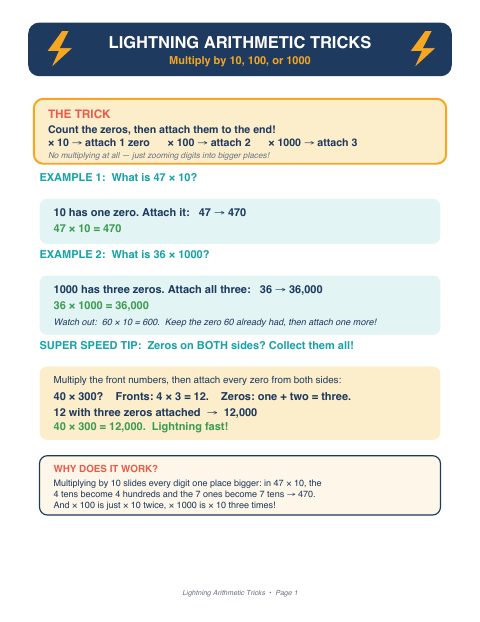
Lightning Arithmetic Tricks
Mental-math shortcuts, each with a "lightning challenge": multiplying and dividing by 10, 100 and 1000 (decimals too), squaring numbers that end in 5, multiplying by 5 and by 11, and more.
-
 Practice
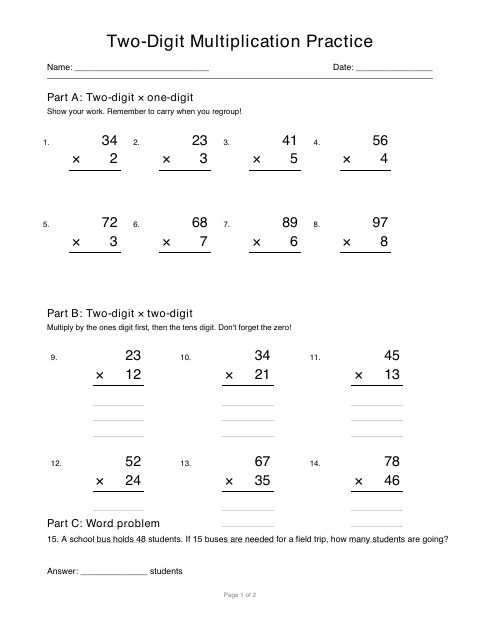
Two-Digit Multiplication Practice
Two-digit by one-digit, then two-digit by two-digit, with room to show the work.
-
 Practice
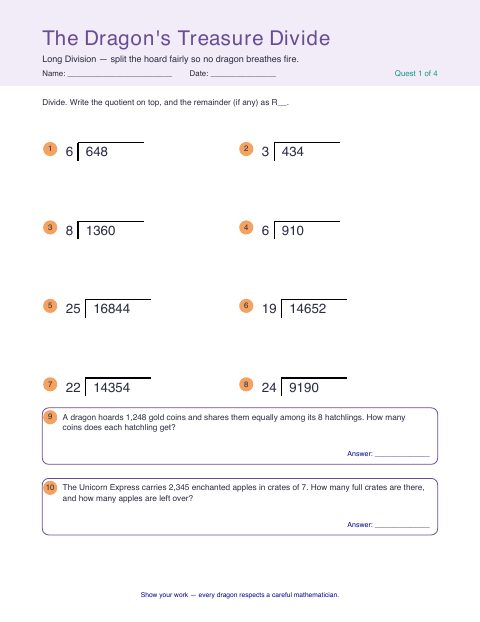
The Dragon's Treasure Divide: Long Division
Four quests of long division with remainders, splitting the hoard fairly so no dragon breathes fire.
-
 Study guide
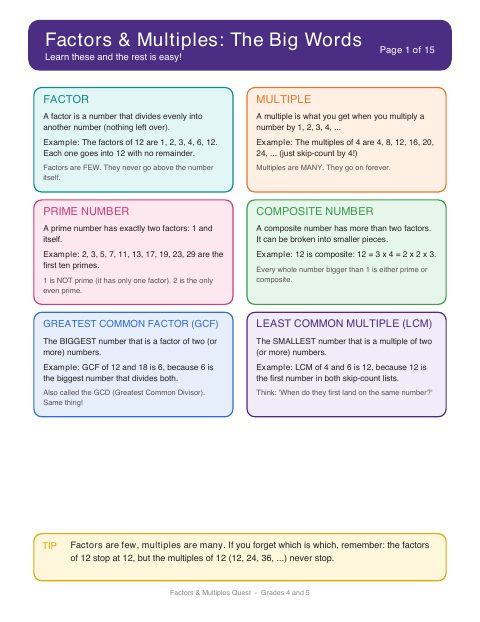
Factors & Multiples Quest: Guide
Factors, multiples, primes, prime factorization, greatest common factor and least common multiple, with worked examples and tips.
-
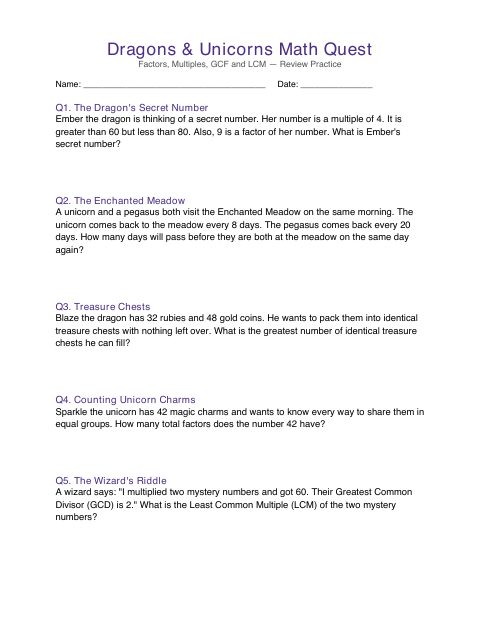 Practice
Dragons & Unicorns Math Quest: Factors, Multiples, GCF and LCM
Review practice: four word problems (a secret number, a meeting day, identical treasure chests, counting factors).
-
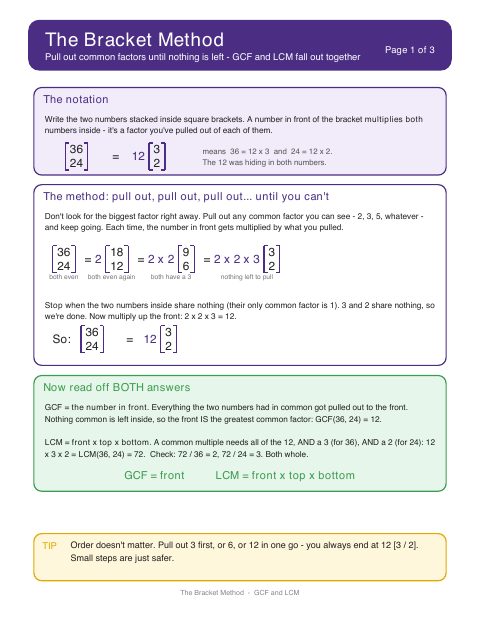 Study guide
The Bracket Method: GCF and LCM
Stack two numbers inside square brackets and pull out common factors until nothing is left: the factors in front multiply to the GCF, and with what remains inside they give the LCM. A worked example and "your turn" practice.
-
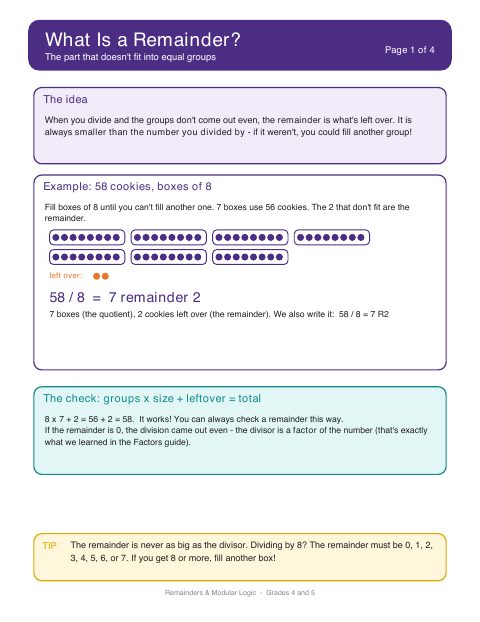 Study guide
Remainders & Modular Logic: Guide
What a remainder is, checking a division, cycles and patterns, days of the week, and last digits of powers.
-
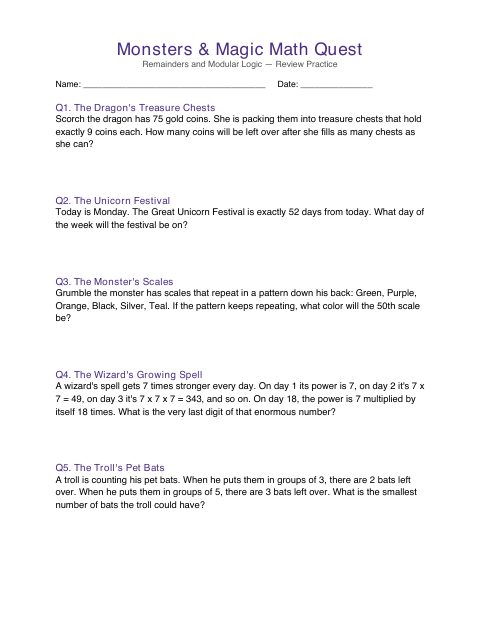 Practice
Monsters & Magic Math Quest: Remainders and Modular Logic
Review practice: four word problems (leftover coins, a festival weekday, a repeating pattern, the last digit of a power).
-
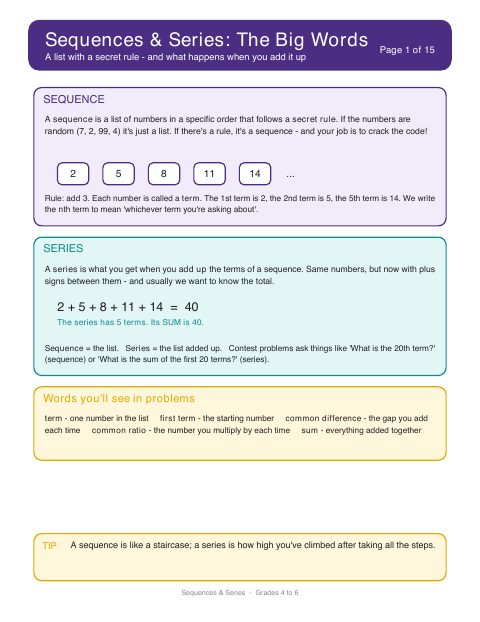 Study guide
Sequences & Series: Guide
A list with a secret rule, and what happens when you add it up: arithmetic and geometric sequences, finding the nth term, square and triangular numbers, and summing a series, with "your turn" practice throughout.
-
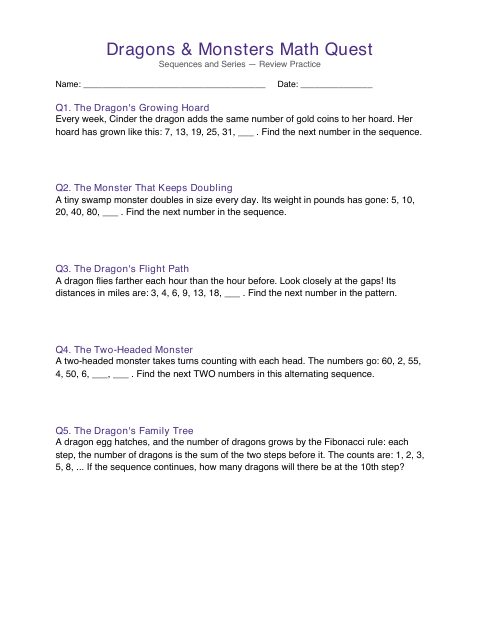 Practice
Dragons & Monsters Math Quest: Sequences and Series
Review practice: a growing hoard, a doubling monster, changing gaps, an alternating two-headed count, and a Fibonacci family tree.
-
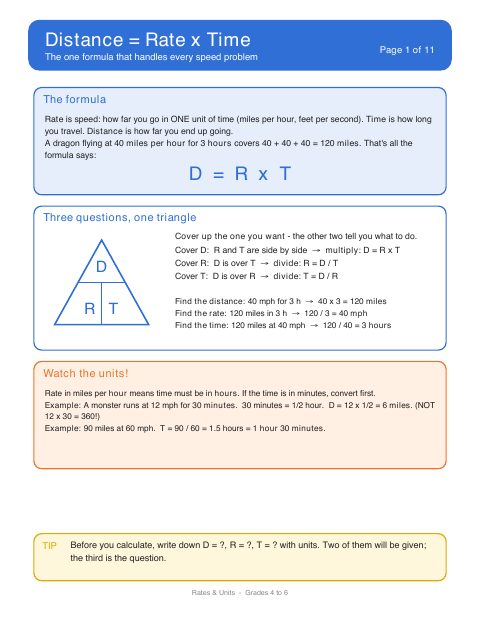 Study guide
Rates and Units: Guide
Distance = rate × time and the cover-up triangle, travelers moving toward each other or chasing, other "something per something" rates, converting units by multiplying by 1, and why a square foot is not 12 square inches. With "your turn" practice.
-
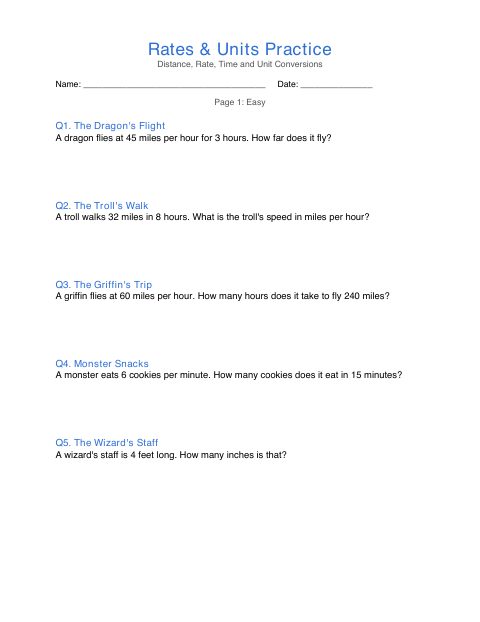 Practice
Rates & Units Practice
Three pages, easy to hard: distance, rate and time with dragons and trolls, minutes as fractions of an hour, two travelers meeting in the middle, and unit conversions.
-
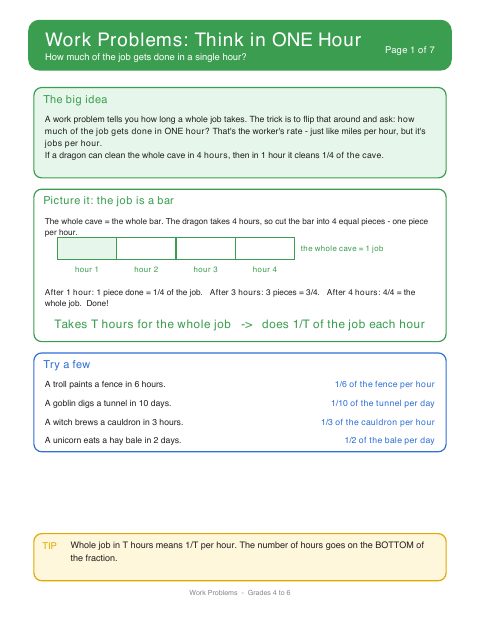 Study guide
Work Problems: Think in One Hour
A worker's rate is the share of the job done in one hour. Picture the job as a bar, add the shares when workers team up, flip to get the time, then handle who is working when. Ends with a cheat sheet.
-
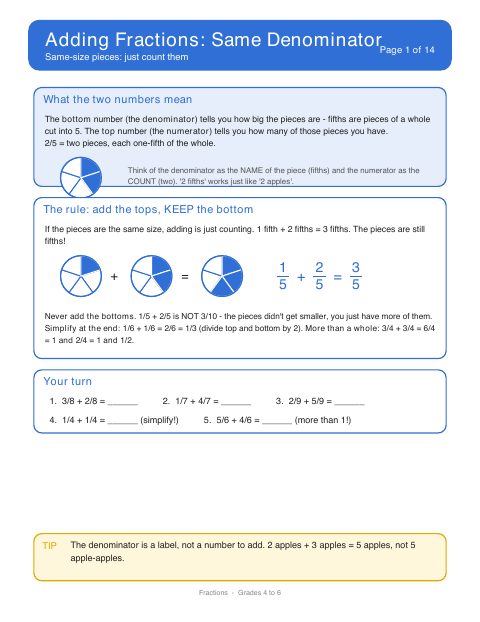 Study guide
Fractions: Guide
Adding and subtracting with the same and different denominators, multiplying, reciprocals and dividing, a fraction inside a fraction, and telling which operation a word problem wants. "Your turn" practice after each step and a cheat sheet at the end.
-
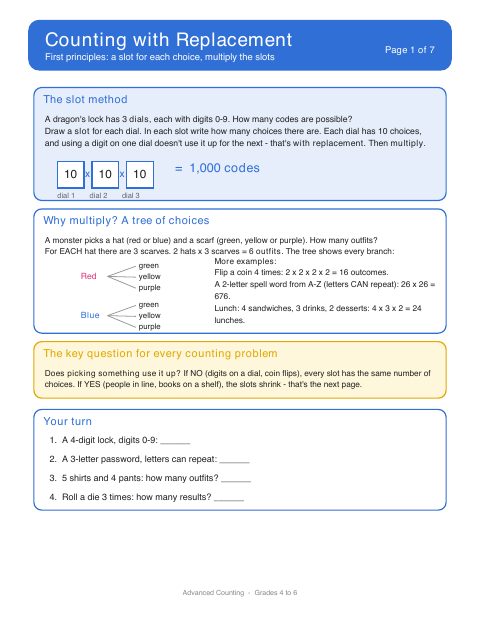 Study guide
Advanced Counting: Guide
The slot method from first principles: counting with replacement, permutations without replacement, permutations with duplicates, combinations, arranging with rules, and the three questions to ask before counting: replacement? order? duplicates?
-
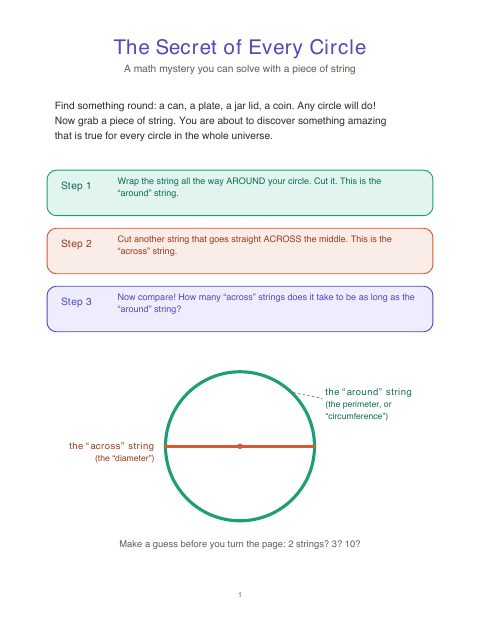 Study guide
The Secret of Every Circle
Discover pi with a piece of string: measure around and across any round thing and see the same ratio appear every time. Circumference.
-
 Study guide
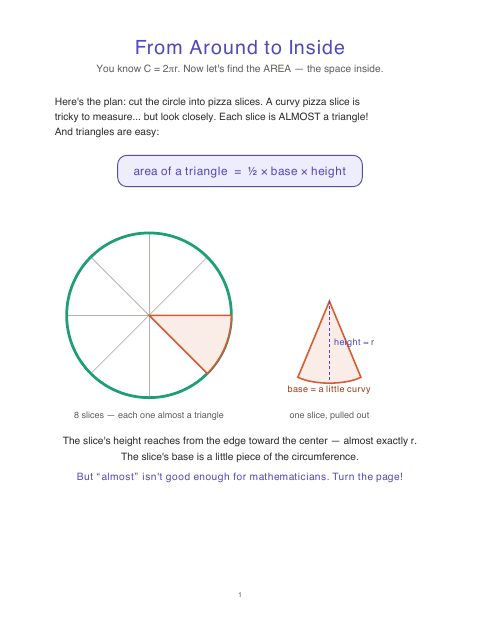
From Around to Inside
The sequel: cut the circle into pizza slices that are almost triangles, and the area formula falls out.
-
 Practice
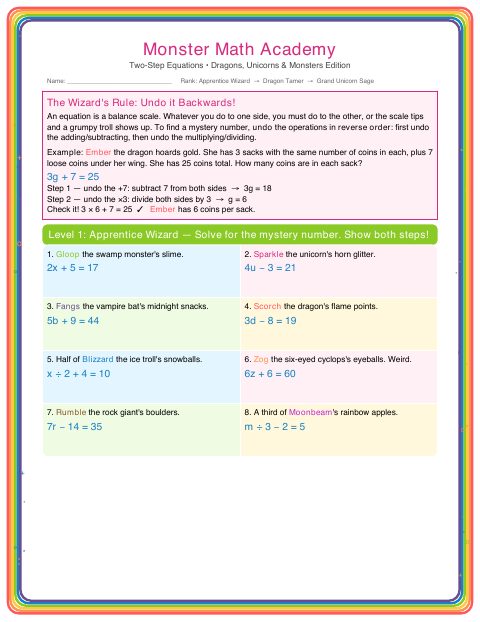
Monster Math Academy: Two-Step Equations
"Undo it backwards": two-step equations, ranked from Apprentice Wizard to Grand Unicorn Sage.
-
 Practice
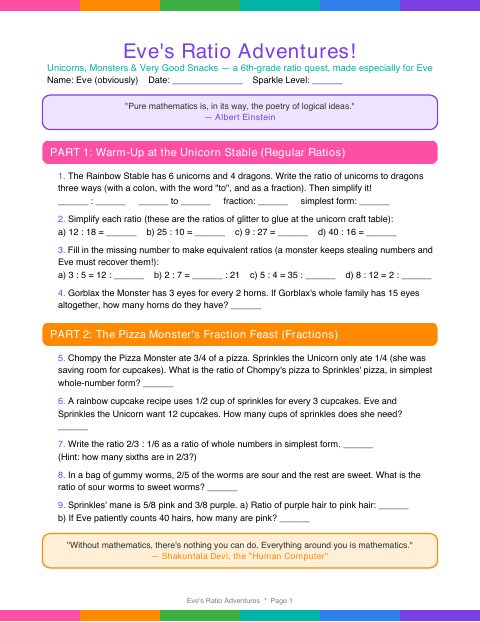
Eve's Ratio Adventures
A ratio quest with unicorns, monsters and very good snacks: writing ratios three ways, simplifying, equivalent ratios and on from there.
-
 Game
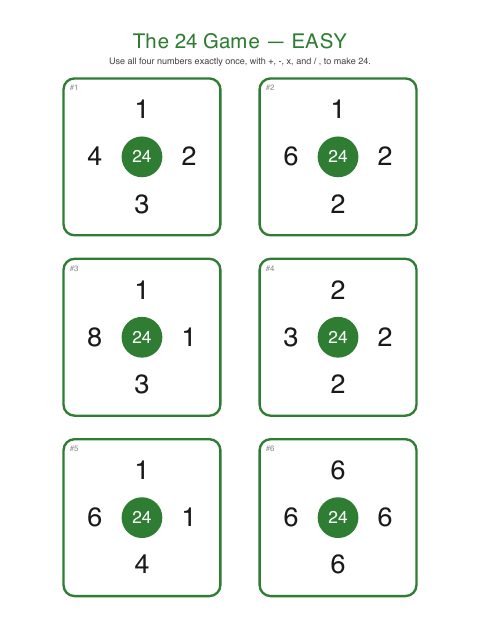
The 24 Game
Boards of four numbers, easy to hard. Use all four exactly once, with +, −, × and ÷, to make 24.
Geometry
-
 Study guide
Honors Geometry Study Guide
The hard concepts of an advanced geometry course, starting with formal proof writing, for a student self-studying beyond the Khan Academy curriculum.
-
 Exam
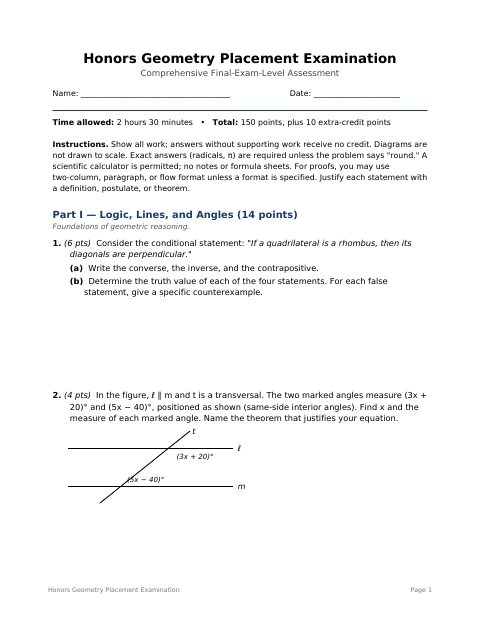
Honors Geometry Placement Examination
A final-exam-level assessment: 2 hours 30 minutes, 150 points plus 10 extra credit. Show all work.
Algebra II
-
 Study guide
Trigonometry Study Guide
Placement-test review and practice: recognize, set up and solve trigonometry problems with exact answers.
-
 Study guide
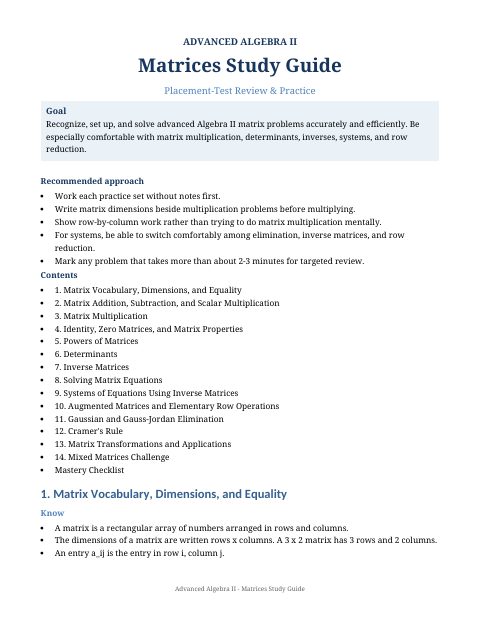
Matrices Study Guide
Matrix multiplication, determinants, inverses, systems of equations and row operations, with placement-test practice.
-
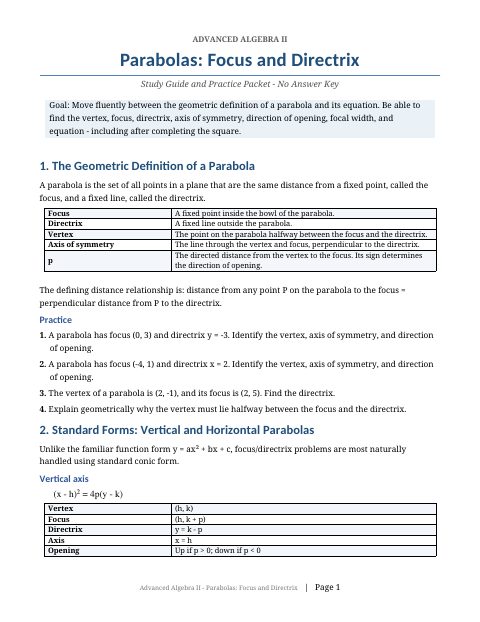 Study guide
Parabolas: Focus and Directrix
From the geometric definition to the equation and back: vertex, focus, directrix, axis of symmetry, focal width, completing the square. Practice packet, no answer key.
-
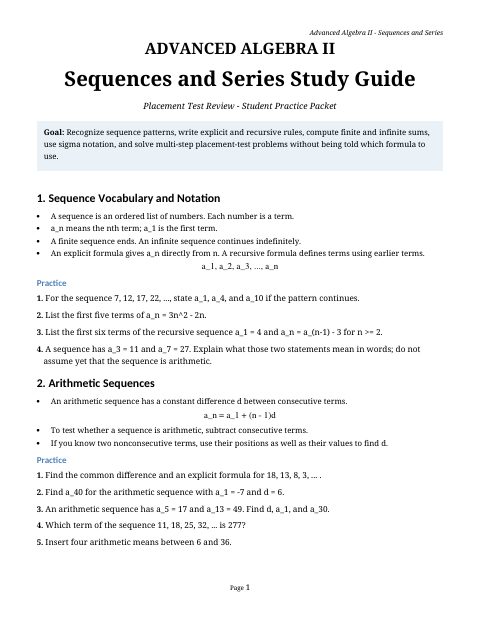 Study guide
Sequences and Series Study Guide
Explicit and recursive rules, finite and infinite sums, sigma notation, and multi-step problems that do not say which formula to use.
Calculus BC
-
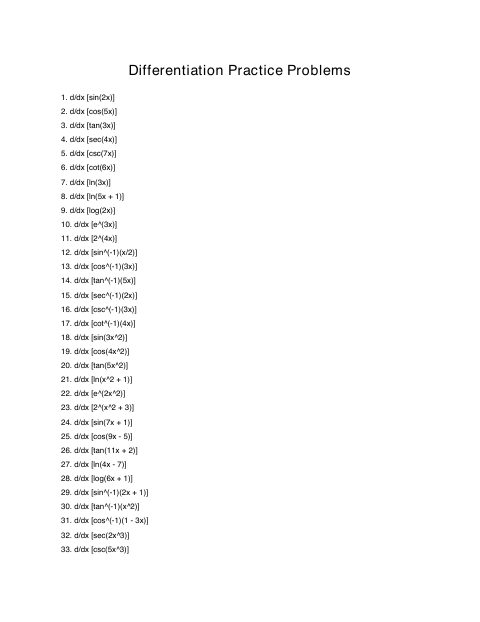 Practice
Differentiation Practice Problems
Chain-rule drill: derivatives of trigonometric, logarithmic and composite functions.
-
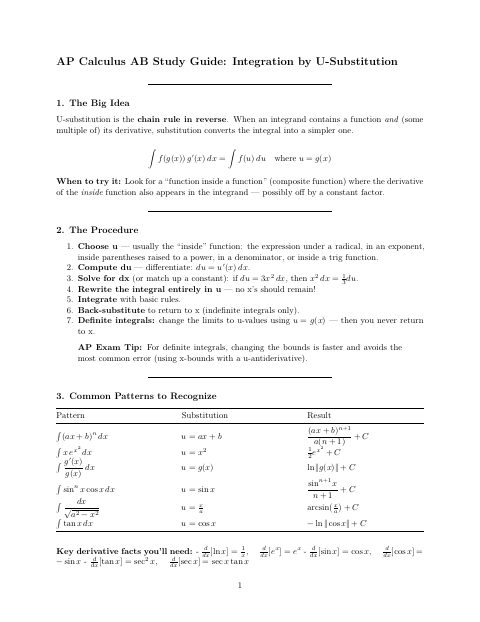 Study guide
Integration by U-Substitution
The chain rule in reverse: when to substitute, how to pick u, and how to handle the bounds of a definite integral.
-
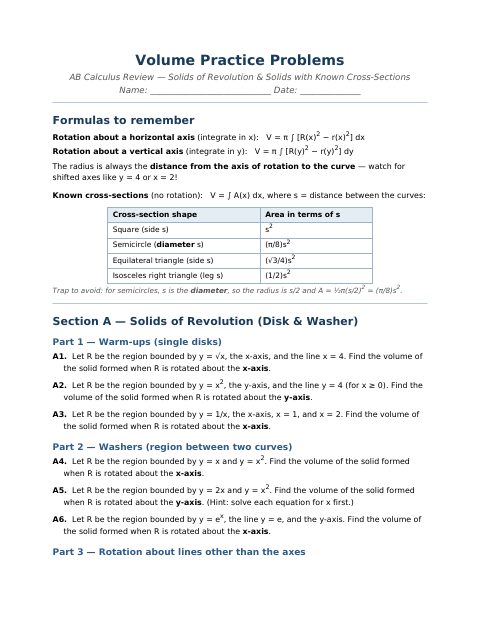 Practice
Volume Practice Problems
Solids of revolution and solids with known cross-sections, with the formulas to remember up top.
SAT
-
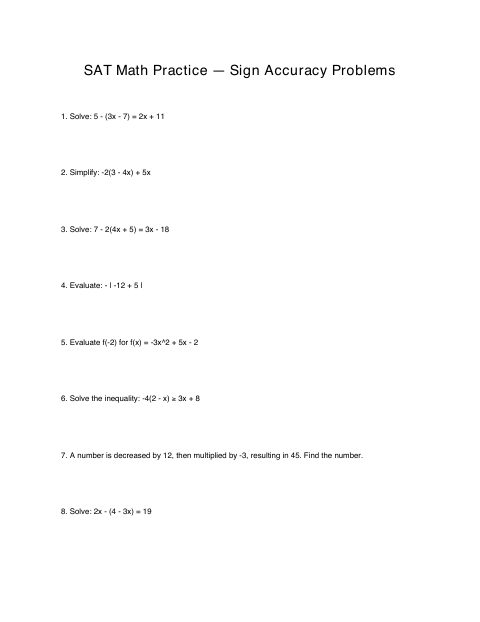 Practice
SAT Math: Sign Accuracy Problems
Problems that are only hard because of the minus signs: distributing a negative, absolute values, evaluating functions at negative inputs. Spaced out for working by hand.
Rubik's Cube
-
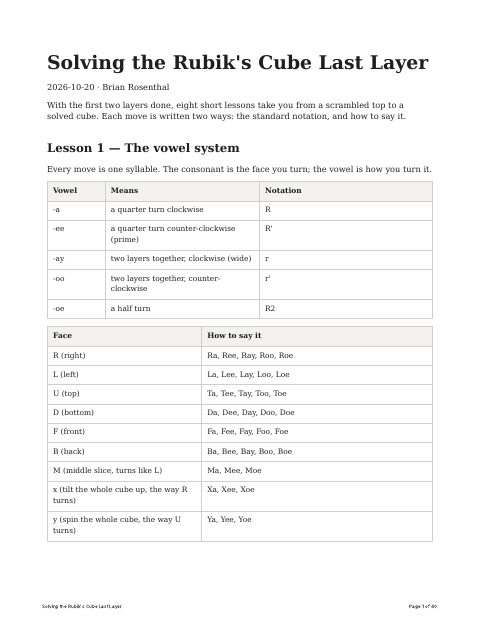 Study guide
Solving the Rubik's Cube Last Layer
With the first two layers done, short lessons take a scrambled top to a solved cube: the cross, Sune, the T and U moves, the H and A perms, the J move, then practice loops. Every move is written in standard notation and in a one-syllable "vowel system" for saying it out loud.